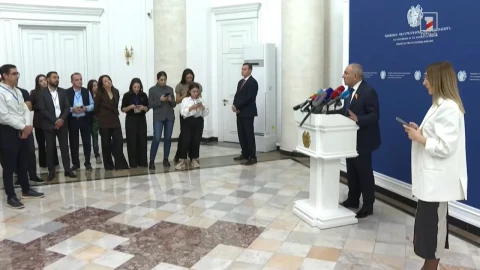


Armenia’s vision on unblocking the regional communications is reflected in the Crossroads of Peace project, Prime Minister Nikol Pashinyan said at a press conference today.
Referring to what is being discussed within the framework of unblocking regional communications, PM Pashinyan said: “”The Republic of Armenia is committed to unblocking regional transport routes and is open to facilitating communication between Armenia’s regions via Azerbaijani territory, and between Azerbaijani regions via Armenian territory. We also support bilateral trade, as well as international transit from Armenia through Azerbaijani territory to third countries, and vice versa.”
The Prime Minister emphasized that Armenia sees all these processes under Armenia’s territorial integrity, sovereignty and jurisdiction and any further discussion will take place within this framework.
Referring to the possibility of delegating the management of those routes to other companies, he noted that even today there are several well-known such cases in Armenia, some of which can be considered successful, while others not as much.
As examples, Pashinyan cited the management of Zvartnots International Airport, the water supply system, and the Armenian railways, all of which are managed by external operators. “I don’t believe Armenia’s sovereignty, jurisdiction, or territorial integrity has been compromised in any of these cases,” he stated. He also referred to previous experience with the outsourcing of Haypost, Armenia’s national postal service.
Importantly, Pashinyan emphasized that while these infrastructures are under outsourced management, they remain the property of the Republic of Armenia. “It is essential to underline that Armenia retains ownership of its railway, Zvartnots Airport, and water system,” he said.
Referring to the unblocking of regional routes within the framework of the “Crossroads of Peace” initiative, Pashinyan mentioned that the government is considering the creation of a company that would attract the necessary investments for the project, which he described as having “enormous investment potential.” According to him, beyond roads and railways, the project also envisions pipelines for oil and gas, power transmission lines, fiber-optic cables, and other infrastructure.
“This is an economic network that needs to be created and managed,” the Prime Minister said, emphasizing that Armenia envisions this network as part of its own sovereign infrastructure.
Addressing public concerns over possible land lease agreements or foreign involvement in infrastructure projects, Pashinyan explained that under Armenian law, such arrangements fall under the concept of “development rights.” He clarified that any infrastructure developed under this framework would become or remain state property after the expiration of the contract.
The Prime Minister also said he could not provide more specifics at this stage, since a wide range of proposals are under discussion. “If there were a finalized agreement, we would be able to speak about it concretely. For now, I am outlining the scope of discussions,” he said.
Speaking more broadly about Armenia’s role in regional logistics, Pashinyan underscored that Armenia has expressed willingness to take certain steps to simplify transport-related procedures as part of the “Crossroads of Peace” project. He added that competition among countries to attract transit of goods and energy flows is increasing, and Armenia must offer attractive conditions to international investors.
“It is surprising that some in Armenia present the reopening of railways through Armenian territory as a tragedy, while the real tragedy is that there is currently no functioning transit railway crossing Armenia,” he said.
“If Armenia were – and I am convinced it will be – a hub for international freight transit, it would become a significant factor of national security,” Pashinyan concluded.