
On Thursday, MEPs voted on a resolution on EU support for Armenia’s democratic resilience, against the backdrop of the upcoming elections. 476 MEPs voted in favor of the resolution on supporting democratic resilience in Armenia, 47 voted against, while 48 abstained.
Armenians are expected to hold parliamentary elections on 7 June 2026. During Tuesday’s plenary debate with Commission and Council representatives, and in Thursday’s accompanying resolution, MEPs stressed the need for a vote free from external interference, “and to raise concerns over attempts by Moscow to sow disinformation and influence the ballot’s outcome”.
In addition, Parliament called for more efforts to strengthen Armenia’s overall democratic resilience, with the EU recently having launched a new civilian mission to support the Armenian authorities with capacity building and to face multi-layered threats such as foreign information manipulation and interference (FIMI), cyber-attacks and illicit financial flows. A dedicated EU-Armenia summit is also planned for 5 May.
The resolution reads:
The European Parliament,
– having regard to its previous resolutions on Armenia,
– having regard to the Comprehensive and Enhanced Partnership Agreement between the European Union and the European Atomic Energy Community and their Member States, of the one part, and the Republic of Armenia, of the other part[1],
– having regard to the law adopted by Armenia’s National Assembly on 26 March 2025 launching the process of Armenia’s accession to the European Union,
– having regard to the address of Prime Minister Nikol Pashinyan to the European Parliament in Strasbourg on 11 March 2026,
– having regard to the joint press statement of 3 December 2025 following the sixth meeting of the EU-Armenia Partnership Council,
– having regard to the adoption of the strategic agenda for the Armenia-EU partnership,
– having regard to the EU-Armenia resilience and growth plan and the EU’s Global Gateway investment commitments,
– having regard to the conclusions of the EU-Armenia Political and Security Dialogue of 3 February 2026,
– having regard to Council Decision (CFSP) 2025/211 of 30 January 2025[2], which extends the mandate of the European Union Mission in Armenia (EUMA) for two years,
– having regard to Council Decision (CFSP) 2026/894 of 21 April 2026[3], which establishes the EU Partnership Mission in Armenia (EUPM Armenia) under the common security and defence policy (CSDP),
– having regard to Council Decision (CFSP) 2024/2010 of 22 July 2024[4], which adopts the first ever assistance measure under the European Peace Facility in support of the Armenian Armed Forces,
– having regard to the ratification of the CSDP framework participation agreement between the European Union and Armenia[5], as welcomed in the joint press statement of 3 December 2025 following the sixth meeting of the EU-Armenia Partnership Council,
– having regard to the Washington Peace Summit of 8 August 2025,
– having regard to the needs assessment mission report, published by the Office for Democratic Institutions and Human Rights (ODIHR) of the Organization for Security and Co-operation in Europe, on Armenia’s parliamentary elections of 7 June 2026, and to the Council of Europe’s work on election standards, media freedom and information integrity,
– having regard to its resolution of 15 April 2015 on the centenary of the Armenian Genocide[6],
– having regard to Rules 136(2) and (4) of its Rules of Procedure,
A. whereas EU-Armenia relations have entered a new phase, marked by a higher level of political engagement and an expanded security relationship; whereas these relations are founded on shared values, including democracy, the rule of law and respect for human rights and fundamental freedoms; whereas the EU-Armenia Partnership Council has adopted a new strategic agenda, as a major step in strengthening bilateral ties, covering democracy, justice reform, human rights and a wide range of further areas building on the Comprehensive and Enhanced Partnership Agreement; whereas the EU has reaffirmed its steadfast support for Armenia’s reform agenda and the country’s efforts to counter hybrid threats, the progress made in the visa liberalisation dialogue and the EU’s EUR 270 million resilience and growth plan for Armenia; whereas Armenia has undertaken significant reforms in recent years; whereas further improvements remain essential;
B. whereas on 26 March 2025, Armenia’s parliament adopted the law on launching Armenia’s process of accession to the EU, thereby expressing the country’s aspiration for EU membership;
C. whereas the new strategic agenda adopted in December 2025, building on full implementation of the Comprehensive and Enhanced Partnership Agreement, covers a wide range of areas, including democracy and the rule of law, justice reform and human rights; whereas this choice of areas demonstrates Armenia’s sovereign commitment to democratic standards and the rule of law, consistent with EU norms and values;
D. whereas the eighth summit of the European Political Community and the first ever EU-Armenia summit will take place consecutively in Yerevan on 4 and 5 May 2026, representing a historic sign of European solidarity with Armenia; whereas the EU-Armenia summit, bringing together the President of the European Council, the President of the Commission and the Vice-President of the Commission / High Representative of the Union for Foreign Affairs and Security Policy, is set to deliver concrete outcomes in bilateral relations, with a particular focus on connectivity in energy, transport and digital infrastructure, and on peace, security and prosperity in the South Caucasus;
E. whereas on 21 April 2026, the Council established EUPM Armenia under the CSDP as a further contribution towards enhancing Armenia’s democratic resilience and its ability to manage crises; whereas the mission will support Armenia in facing multilayered threats such as foreign information manipulation and interference (FIMI), cyberattacks and illicit financial flows; whereas the establishment of the mission confirms that democratic security is now a core pillar of the EU-Armenia partnership; whereas EUPM Armenia will provide strategic advice and capacity-building to Armenia’s institutions to help them respond to such threats;
F. whereas on 7 June 2026, Armenia will hold parliamentary elections, which are strategically important not only for domestic democratic consolidation but also for the sustainability of peace, reform and closer cooperation with the EU; whereas the integrity of the elections depends on having the conditions for free, fair and competitive elections, strong institutions, independent media and robust safeguards against disinformation, illicit financing, vote-buying and other forms of malign interference; whereas ODIHR has recorded concerns regarding the preparedness of precinct commissions, cybersecurity, early campaigning, the misuse of administrative resources, the transparency of campaign financing, and media polarisation; whereas foreign interference – notably Russia’s systematic hybrid operations carried out with the help of its proxies, including disinformation campaigns, cyber operations, economic pressure and the mobilisation of local proxies – has increasingly operated through domestic amplifiers such as certain religious actors and oligarchic networks, mirroring patterns observed in recent elections in Moldova and Georgia;
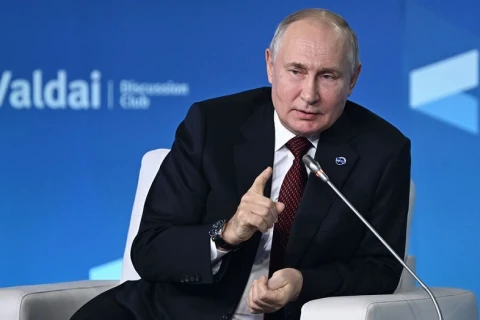
G. whereas during their meeting on 1 April 2026, Vladimir Putin put pressure on Armenian Prime Minister Nikol Pashinyan to allow detained Russian-Armenian billionaire Samvel Karapetyan to participate in Armenia’s upcoming elections;
H. whereas EUMA continues to play a vital role in contributing to stability, confidence-building and human security in conflict-affected areas; whereas on 30 January 2025, the Council extended EUMA’s mandate for two years; whereas EUMA plays a vital stabilising role along the Armenian-Azerbaijani border; whereas it also contributes to observing and reporting on the situation on the ground and supporting confidence-building between Armenia and Azerbaijan;
I. whereas the Armenia-Azerbaijan peace process has gained significant momentum, with plans for multimodal transit connectivity through Armenian territory linking mainland Azerbaijan with its Nakhchivan Autonomous Republic, while fully respecting Armenia’s sovereignty, territorial integrity and jurisdiction, and represents a key instrument for reducing Armenia’s economic dependence on Russia; whereas the EU, through the EU-Armenia Connectivity Partnership and the Crossroads of Peace initiative, fully supports this process;
1. Affirms its strong belief in the commitment of the Armenian authorities to uphold free, fair and transparent elections and expresses its support for their efforts to protect democratic institutions against external interference;
2. Expresses its full support for free, fair, competitive and peaceful parliamentary elections in Armenia in June 2026, the outcome of which the Armenian people alone must determine; underlines the importance of the independence of electoral administration, equal campaign conditions for all candidates, media pluralism and full respect for fundamental freedoms throughout the electoral cycle; calls for robust safeguards against disinformation, illicit financing, vote-buying and coercion, and the enhanced protection of electoral infrastructure, the transparency of campaign financing, and support for fact-checking initiatives and civil society, including through information-sharing and early-warning mechanisms; calls for robust international and domestic election observation missions, including by ODIHR, and full cooperation with such missions;
3. Strongly condemns FIMI, disinformation campaigns and other hybrid threats directed at Armenia, notably those emanating from Russia and its proxies, including through cyberattacks, illicit political financing and the use of domestic actors, including oligarchic networks, to amplify such threats; stresses that these threats are structural and long-term in nature and sustained efforts are required to strengthen democratic resilience beyond the electoral cycle; welcomes, in this regard, the establishment of EUPM Armenia and calls for enhanced EU support through strategic communication, media literacy, capacity-building in the area of cybersecurity, and structured engagement with online platforms; calls on the Armenian authorities to guarantee full respect for opposition rights, judicial independence and freedom of expression;
4. Notes the specific challenges linked to the presence of a sizeable Russian community, including dual nationals, in Armenia, and stresses the need for vigilance against any attempts to exploit this situation for electoral interference;
5. Welcomes the strong momentum in EU-Armenia relations and Armenia’s continued commitment to democracy, the rule of law, human rights and ambitious political and economic reforms;
6. Welcomes the adoption of the new strategic agenda for the EU-Armenia partnership, the progress made in the implementation of the Comprehensive and Enhanced Partnership Agreement, the advances in the visa liberalisation dialogue, and the continued implementation of the resilience and growth plan; welcomes, in this regard, Armenia’s legislative and policy efforts that aim to deepen relations with the EU;
7. Welcomes the holding of the eighth European Political Community summit and the first ever EU-Armenia summit in Yerevan on 4 and 5 May 2026 as an exceptional and historic milestone; considers that the consecutive hosting of both summits in Yerevan sends an unambiguous political signal of pan-European solidarity with Armenia and of the EU’s commitment to supporting Armenia’s peace, reform and resilience agenda; calls on EU and Armenian leaders to use this opportunity to develop ambitious and concrete deliverables;
8. Welcomes the adoption of legislation expressing the country’s aspiration for EU membership and calls for the EU institutions and the Armenian authorities to support this political choice with practical steps, anchored in democracy, the rule of law and fundamental rights;
9. Calls on the Commission, the European External Action Service and the Member States to deepen cooperation with Armenia on democratic governance, the rule of law, judicial reform, anti-corruption, cybersecurity and resilience to hybrid threats, and to increase accessible support for independent media, civil society, local institutions and reform-oriented public administration; calls for close coordination with international partners in supporting these efforts;
10. Strongly supports Armenia’s continued efforts towards peace, reconciliation and the full normalisation of relations with Azerbaijan; welcomes the progress achieved in the peace process and calls on both sides to move towards a comprehensive, legally binding peace agreement; stresses that any sustainable peace must be grounded in respect for sovereignty, territorial integrity and the inviolability of borders;
11. Encourages enhanced information-sharing and cooperation with the Republic of Moldova, facilitated by the EU, in the light of comparable experiences of electoral interference;
12. Reiterates its support for the rights of Nagorno-Karabakh Armenians, including the protection of their identity, property and cultural heritage, and their right to a safe, unimpeded and dignified return under appropriate international guarantees; calls for those responsible for the destruction of Armenian cultural and religious heritage to be held accountable, and for an international assessment mission;
13. Condemns Azerbaijan’s unjust detention of Armenian prisoners of war, detainees and hostages; demands their immediate and unconditional release; notes the steps taken so far and calls for further confidence-building measures; calls for full respect for international humanitarian and human rights law;
14. Calls for the EU to step up financial and technical assistance to Armenia, including through the resilience and growth plan, with a focus on strengthening institutional resilience, energy security, digital governance and economic diversification, and reducing structural dependencies in critical sectors such as energy, transport and infrastructure; encourages the Armenian Government to follow up on the reforms;
15. Welcomes the adoption of the EUMA civil society strategy; considers it an important step in broadening the mission’s engagement with Armenian civil society beyond its core security monitoring mandate, and encourages EUMA to strengthen its outreach to local democratic actors, community organisations and independent media as part of its contribution to democratic resilience; commends the work of Armenian civil society on investigating foreign interference campaigns, cyberattacks and online disinformation;
16. Welcomes continued efforts towards the normalisation of relations between Armenia and Türkiye, as an important contribution to regional stability, reconciliation and connectivity; calls on both parties to continue to engage in good faith in further confidence-building steps, including the reopening of borders, as an important contribution to regional stability, reconciliation and connectivity;
17. Instructs its President to forward this resolution to the Council, the Commission, the Vice-President of the Commission / High Representative of the Union for Foreign Affairs and Security Policy, the governments and parliaments of the Member States, the President, Government and Parliament of the Republic of Armenia, the Organization for Security and Co-operation in Europe, the Council of Europe and the United Nations.