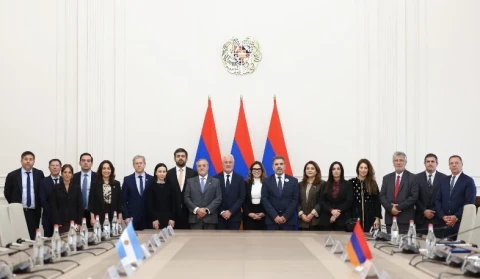


Prime Minister Nikol Pashinyan gave an interview to British media representatives. Below is the full interview.
Question – The Guardian: Patrick Wintour – I have a question that really want to ask you. You are surrounded by 4 largish authoritarian countries – Russia, Iran, Turkey, Azerbaijan. You lost a war quite recently. How much are you worried that you are taking a big risk by trying to get closer with the West. And do you see that there is a serious chance for Armenia to join the European Union in the next decade.
Prime Minister Nikol Pashinyan - Thank you, but I need to clarify some things about your question, because listing the countries that surround us is not correctly reflected, because our neighboring countries are Iran, Turkey, Georgia and Azerbaijan.
We do not share a direct border with the Russian Federation, but of course the Russian Federation is a serious and significant player in the South Caucasus region. As to what you said about coming closer with the West, actually we were never far from the West. As for the numerous examples that after the 2018 People's, non-violent, velvet revolution our relationship with the West has come much closer, before the revolution Armenia and the EU had signed the Comprehensive and Enhanced Partnership Agreement, and the responsibility of implementing that agreement fell on our Government.
Of course our achievements in the field of democracy have created an objective reality where our relationship can develop dynamically. But if we step aside for a moment from the current media stream, nothing unpredictable is actually happening, especially that after the 2018 revolution we said that democracy for us is not a policy adopted by virtue of circumstances, it is a strategy for us. There is another circumstance that is significant and that circumstance is the diversification of foreign and security relations.
But to be very direct and sincere, it's not a cause, it's a consequence, because we are diversifying our foreign relations, but we are not the only ones doing that. Practically, around the world, you would not find any actor which is not diversifying its foreign relations, even those who prior to 2022 thought they were sufficiently diversified.
Everyone is diversifying their foreign relations, and Armenia could not step aside this new trend. As to further rapprochement with the European Union, I said in my speech before the European Parliament that the Republic of Armenia is ready to be as close with the European Union as the European Union sees it possible.
At the moment we seem to be moving in this direction, because, very importantly, this is happening publicly, this is a public process. Especially after the trilateral meeting in Brussels on April 5, there have been allegations that we and the EU have reached some "secret deals". But no, transparency is of utmost importance for us. Our agendas have been made public, the results have been made public, and we do see, to an extent, coming closer with the EU, but I am not seeing anything extraordinary happening there, because that's a course that is not newly adopted by the Republic of Armenia.
Question – The Independent: Kim Sengupta – I want to ask about international support for Armenia, and the leverage some countries may have over Azerbaijan. "British Petroleum" has supplied Azerbaijan with 35 billion USD worth oil and gas in the last 4 years and that's 4 times the size of the Azerbaijani defense budget. This gives the UK some leverage over Azerbaijan through "British Petroleum". Would you like to see the UK using that kind of leverage? And following on from that, again the question on support: Azerbaijan has been getting huge quantity of arms from Russia, Turkey, Israel. I know that Armenia is now getting some weapons from India, France. Would you like to see other countries intervene, so that Armenia had the means to defend itself?
Prime Minister Nikol Pashinyan – You see I would not like to comment on business activities and investments made in the neighboring countries, but one thing I can say is that any investment should be motivated by having peace in the region or the environment it's made.
In general, establishing peace is in the interests of the international community and the investors, but of course, the primary beneficiaries of peace are Armenia and Azerbaijan. And this theoretical premise, which is of course very theoretical, could step by step be manifested in more substantive terms. In the last 5 minth we have achieved two major agreements with Azerbaijan. Eventually, the peoples of Armenia and Azerbaijan are keen on peace.
Of course, the investors and broader economic stability are interested in peace, but we are the primary beneficiaries of peace. So a number of statements coming from Azerbaijan regarding the reforms of Armenia's army and modernization are alarming us. You are right pointing out that there is a strong misbalance between the military budgets of Azerbaijan and Armenia and that is also the results of the deals you referred to that generates income for Azerbaijan, but what we are worried about is that even with this misbalance, Azerbaijan is responding very aggressively to the reforms of Armenia's armed forces and to the acquisition of arms and equipments, although everyone understands that these acquisitions are of solely defensive nature.
As I have repeatedly said that no country can challenge the right of another country to have a combat ready army and I think having a strong army is sometimes used for war, but having such an army is also important for peace, for balancing the powers. That's also the reason why when Azerbaijan raises those questions, referring particularly to Armenia's acquisition of weapons, which is not more than 15-20% of Azerbaijan's acquisitions in terms of cost and volume, and our acquisitions are mostly of defensive nature, we respond to those statements.
We invited Azerbaijan to introduce a bilateral arms control mechanism, so that we can mutually agree upon a way to avoid provoking arms race in our region.
We proposed and we continue to propose simultaneous withdrawal of troops from the border declared on the bases of the 1991 Alma-Ata declaration. That proposal still stands. We also invited to sign a non-aggression pact before even any peace agreement. A pact on non-aggression is a much simpler one, and now, when the 1991 Alma-Ata declaration is being used as the bases for the delimitation process, we can sign a simple paper promising that we will not attack each other on the bases that we have recognized each other's territorial integrity and do not have territorial claim from each other.
Therefore, I think we should continue our work with this logic. The agreement reached last Friday between the Delimitation commissions of the two countries could contribute to stability.
Let's ask another question. We speak about the military budgets, but of course durable and longer-term peace would enable all of us to spend less resources on arms and direct them to the solution of socio-economic problems of our countries.
This year, Armenia progressed a lot in terms of GDP per capita, but still Armenia and Azerbaijan have numerous social problems. And when it is possible and when we have peace, it will enable the governments of both countries to invest in socio-economic developments, and also at some point, we could also think about regional economic development.
It is in the context of the regional economic development, that we adopted and introduced the Crossroad of Peace project, which I hope you are aware of. We are thinking along those lines. What I mean is that we are not preparing for war, we are preparing for peace. On the other hand, though, as long as we are not convinced that the Republic of Armenia will not undergo attack, we naturally have to build up our defensive capabilities. As I have said, the Republic of Armenia does not have any ambitions in any directions beyond the 29.743 km2 territory. And we think this is the foundation based on which we need to build and develop our sovereignty and independence.
Question - The Telegraph and the Critic: Michael Mosbacher – Your current security arrangements have not worked out. The Collective Security Treaty has not benefitted Armenia in its recent conflict with Azerbaijan. How will that relationship continue? What's the benefit of the Collective Security Treaty Organization for Armenia? What is the future of the Russian military bases in your country?
Prime Minister Nikol Pashinyan – As to regional security, we think that we can address this problem as part of the peace process. And it's important that the peace process is not only the work on the peace treaty, which is underway. But it's important to note that we have embarked on the practical stage of border delimitation process, which is of extreme importance in terms of, among other things, reducing security risks, and we need to move in this direction. As to the Collective Security Treaty Organization, a fundamental problem emerged there, because even with Azerbaijan we managed to agree in principle on recognizing each other's territorial integrity based on the 1991 Alma-Ata declaration, and the 1991 Alma-Ata declaration is accepted as the political bases for the border delimitation process. I would like to clarify what this means in practice.
From the point of view of our discussions, the 1991 Alma-Ata declaration contains two important elements. First is that the Soviet Union shall cease to exist, and this was the agreement reached between the 12 former Soviet Union republics, all the republics with the exception of the Baltic states, which at that time had already declared independence, and the administrative borders that existed between the Soviet republics shall turn into state borders. So now we clearly know where the border lies between the Republic of Armenia and the Republic of Azerbaijan. And importantly, the fact that we accept the Alma-Ata declaration as the political bases for the delimitation process has an important meaning that we shall not draw a new border between Armenia and Azerbaijan. We simply need to reproduce on the ground the borders that existed at the time that the Soviet Union collapsed. Those were the de-jure borders within the Soviet Union.
Now, how is all this related to the CSTO? It is very directly related to the CSTO. The administrative borders, that according to the Alma-Ata declaration became borders, these borders define the zone of responsibility of the CSTO. What that means is that if that border is breached, the security mechanism of the Collective Security Treaty Organization should engage.
Now what’s the problem that has emerged in our relationship with the CSTO? The problem is as follows: when that border was breached in May 2021, in November 2021, in September 2022, Armenia according to the established procedure initiated the mechanism for the crisis response, but that mechanism did not get engaged with the explanation that the borders have not been delimited. And recently such a statement was made by the Russian Federation that the CSTO did not engage at that time because there was no delimited border or any border at that time, but our colleagues failed to acknowledge that if there is no delimited border there, does that mean that there is no zone of responsibility for the CSTO as well, because the border is there, and everyone knows where the border lies.
So they are saying that the zone of responsibility of the CSTO cannot be identified by them, but this in fact means that they are saying that the CSTO does not exist, because the border between Japan and Russia is also not delimited. I know that this is not the intention of our colleagues, but if such were the situation, Russia has borders with certain countries which have not been delimited, and if they were in a similar situation in which the armed forces of any country were to enter the territory of the Russian Federation through a border that was not delimited, would then the CSTO not respond in any way? And that would mean that the CSTO does not exist as a mechanism upon which the member states, Russia, Armenia, and the other member states, could rely.
And that’s our question. If we were relying on an organization on which one should not rely on, because in principle, one cannot rely on that organization, not only we, but also others cannot rely on that organization, and it’s justified by the organization’s reaction and statements of some of the member states, and our society asks why we continue to be a member state of the CSTO? Frankly, I do not have an answer to that question.
Question – Adam Smith Institute: James Price – I want to ask about the extent you think Azerbaijanis, and even Russians, are sincere in their desires to move towards normalization, or they are paving the way for the future hostile of aggressive activities?
Prime Minister Nikol Pashinyan – When I spoke about the diversification of relationships, I said that everyone is diversifying their relationships, Russia also is diversifying its relationships in the South Caucasus. It began before us. And that’s where the issue with the CSTO emerged, because currently within the CSTO, and from the positions of the CSTO, and this began quite a long time ago, even before the 2020 war, Russia conducted an equal and parallel policy towards Armenia and Azerbaijan.
The policy of diversifying relationships in this region started from the Russian Federation, actually there is a date of it, between 2012-2013 Russia’s policy was that Armenia was Russia’s ally in the South Caucasus, and Azerbaijan was a partner, and, by the way, that was all in the framework of the CSTO. The whole meaning of that was that the CSTO was very specifically to safeguard the security of the Republic of Armenia. But in 2013 Russia and Azerbaijan signed several billion USD worth arms acquisition contract, and that was the point after which the Russian Federation started to diversify its relationship with Azerbaijan.
I want to draw our attention to the fact that on February 21 or 22 of 2022 Russia and Azerbaijan signed a strategic partnership declaration. That declaration stipulates, among other things, the need to agree upon policies, and this is a public document. One can assume that something that is declared between countries, including security cooperation, consultation on policies, is actually happening, otherwise such a declaration would have no meaning.
Why would countries sign a declaration if they were not to implement it? Especially when even before the signing of that declaration there were at least two situations in which it was clearly manifested that the CSTO was not implementing its responsibilities towards Armenia.
There is a recent interesting case, when our counterparts from the Russian Federation say that they suggested sending the CSTO peacekeepers to the Armenia-Azerbaijan border. I am sorry, but that statement destroys the functionality of the CSTO, because if they were to come, they would have come to the Armenia-Azerbaijan border as an ally of Armenia, not as peacekeepers or peacemakers. Many say Armenia said about the CSTO this or that, or this is what Armenia did within the CSTO, but Armenia did nothing to the CSTO, the CSTO did to itself with its statements, actions and inaction.
Under these circumstances we cannot pretend that we are not noticing all of that. At the moment we have in practice frozen our participation in the CSTO, and as I can see if there is still a possibility of warming up our relationship with the organization, but if things continue the way they are, if the political statements continue, than that line will also be crossed for resuming participation in the CSTO, which will then be rendered as practically impossible.
Question – The Guardian: Lewis Baston – Thank you Mr. Prime Minister. I have just recently written a book about borders. My interest is about the displaced people formally inhabiting Nagorno Karabakh, who are settled in the Republic of Armenia. The short-term policy, as I understand, is to help with housing, education, work. This raises the question about the longer-term future of these people. Do you see the right to return as part of the comprehensive settlement, or is this chapter closed and the Armenian society will grow together within its current borders with the people formerly residing in Nagorno Karabakh?
Prime Minister Nikol Pashinyan – Our policy is as follows: if our sisters and brothers forcibly displaced from Nagorno Karabakh realistically have no possibility or desire to go back to Nagorno Karabakh, then we will do our best for them to stay in the Republic of Armenia. I also wish to inform you that recently, during one of my visits to the regions of Armenia, I was approached by a woman who was forcibly displaced from Nagorno Karabakh, and she asked me how realistic is that they will have a possibility to go back to Nagorno Karabakh and she asked me to give her a direct and sincere answer.
I told her that I will give a direct and sincere answer. In the current situation, given the perceptions that prevail in our region, and the perceptions that prevail in Azerbaijan, and the perceptions that prevail among the Armenians of Nagorno Karabakh, with all these perceptions, I do not consider it realistic. And I said that I cannot lie to her, because if it were realistic, then the displacement from Nagorno Karabakh would not have happened.
Additionally though, the Government of the Republic of Armenia has done its best and in the final days of September 2023 we were accused of allegedly, this was not the case of course, and that accusation came in part from those in power in Nagorno Karabakh, allegedly of not allowing the people of Nagorno Karabakh to find salvation by moving to the Republic of Armenia.
At that time, here is what we were thinking: we wanted to do our best to create conditions, as far as we were concerned, because understandably this decision was not only up to us, to do our best to ensure that the forced displacement and ethnic cleansing of the people of Nagorno Karabakh did not happen. But our efforts were in vain.
And quite the opposite, there were some forces that under those circumstances wanted to draw the Republic of Armenia into war, having their far-reaching goals. Going back to the questions answered earlier, one thing I told you was that the Republic of Armenia is not preparing to fight a war for Nagorno Karabakh. I told that the Republic of Armenia has no aspirations beyond its international recognized borders. And we hope that in the border delimitation process the territorial integrity of the Republic of Armenia will be restored.
By the way, with the decisions being taken already today in the border delimitation process we have already demonstrated that we are candid. We have demonstrated that we are sincere because one thing we did was that we noted that the Government of Armenia is ready to take steps within its powers so that in those 4 Azerbaijani villages, which are Kizilhajili, Kheyrumli, Ashagh Askipara, Baghanis-Ayrum, where no people currently live, life becomes possible, making it possible for them to live there.
But we are also stating that as a result of that same process, it should become just as possible for people to live a life free of stress in Baghanis, Voskepar, Kirants and Berkaber villages of the Republic of Armenia, for people to live in their homes, create family and have children without concerns for security.
But that’s the tis is the point on which the governments of Armenia and Azerbaijan need to convert the theoretical peace agenda into a concrete peaceful reality. It’s true, this is a local section on which we have agreed, but the quality of implementation of these local agreements will increase or decrease trust in the peace agenda and feasibility of peace.
I believe it will increase trust in peace among the Armenian and Azerbaijani societies and will build up a stock of confidence. Let’s agree that there is a profound lack of confident. And I want to say words of praise to the members of the border delimitation commissions and for the work done by the two co-chairs, who have tried to build trust and confidence molecule by molecule. And if treated delicately and with care, it can develop, and if not treated with care, it may fall apart. These commissions are led by the Deputy Prime Minister of Armenia Mher Grigoryan and Deputy Prime Minister of Azerbaijan Shahin Mustafayev.
Question – BBC: Giles Fraser – Armenia is the oldest Christian country in the world. Could you describe the destruction that has been going on to churches, crosses and tombstones?
Prime Minister Nikol Pashinyan – You know spiritual values have material manifestations and in Christianity that’s not of a secondary importance. Protection of historical and cultural monuments is an important task and it becomes quite acute in conflict zones in particular. I think it’s very important here that we create an atmosphere of confidence in the region and overcome the atmosphere of hostility.
Because after all, with the negative attitude towards the historical and cultural monuments and legacy, people are actually expressing hostility towards one another. This is not a living creation, it’s a monument, you might think why, what is the need for attacking a breathless monument and damaging it, but it’s the people’s way of expressing their hostility towards one another.
And the solution to that problem is again through overcoming hostility. Of course, these monuments, especially the churches, have a history, spirit, they are places of worship, sacred places, and desecrating them is a manifestation of hostility. So, we cannot say let the hostility go on, grow deeper, but we protect the monuments. That’s impossible.
The security of monuments can be protected if people do not feel hostility when they look at these monuments, or at least they feel a manageable degree of hostility to not set the bar too high. I think of that as part of the peace agenda.
There is another dangerous theory there, that the movement for the preservation of monuments and being consistent in that issue is very important, but it is also important that this process is not used for intensifying hostility.
It’s a very delicate thing, but it’s happening, because if you are desecrating what’s sacred for the other, that sense of animosity, hostility will naturally go deeper. And if we want it to not happen, then we need to follow-up with the implementation of the peace agenda, because that’s not a stand-alone issue, it is part of the parcel of this peace agenda.
I see the solution to all these issue by going back to Armenia-Azerbaijan peace agenda with the three fundamental principles upon which peace should be built. The three main principles of peace between Armenia and Azerbaijan have already been documented. They are as follows: firstly, Armenia and Azerbaijan recognize each other’s sovereignty and territorial integrity on the bases of the 1991 Alma-Ata declaration, secondly, Armenia and Azerbaijan take the Alma-Ata declaration as the political basis for the delimitation process and thirdly, regional communications will be opened under sovereignty and jurisdiction of states, based on the principle of reciprocity and equality. This third principle is articulated in our “Crossroad of Peace” initiative, which is an important instrument for overcoming animosity, along with the first two principles.