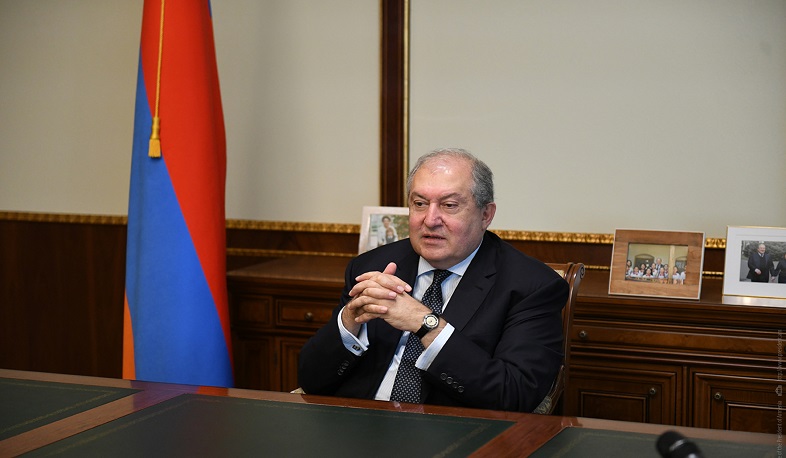
The RA President Armen Sarkissian gave an interview to the British The Critic periodical.
Kapil Komireddi: Russia brokered a temporary truce on Saturday. It was violated within minutes of its signing. Who broke it?
Armen V Sarkissian: Factually, it was the Azeris. At 12 o’clock the ceasefire was announced, and immediately after that there was shelling of the civilian population of Stepanakert. That’s the fact. And if you’re looking to understand why they shelled, well, it’s all logical, because the Armenian side did not start this war. The Armenian side is fighting for their homes. A victory for Armenians means protecting your home, your house, your children, your grandchildren, your grandparents, your heritage, the life you had there for thousands of years—not hundreds of years, but thousands of years—and protecting your religion. And that is why, if you look at the military structures in Karabakh, all military units are always away from the villages and the cities. You know why? Because they worry that their presence could jeopardise the safety of the civilians. They don’t want to give the enemy the opportunity of harming the civilians by using the excuse that the military was the target. The civilians are their families. Armenians did not start the war and they do not have any intention of continuing it. It’s Azerbaijan that started it with the aim, they claim, to “free” Nogorno-Karabakh from the Armenians, who are the majority there.
KK: A missile struck the city of Ganja in Azerbaijan. Ganja is outside the disputed region. What possible justification can there be for striking it?
AVS: I can speak as president of the republic, on behalf of the Armenian government, and on the basis of the information that I’m provided by the ministry of defence of Armenia. The ministry of defence, and the foreign minister in his interviews the day before, clearly stated that it was not Armenia that hit Ganja. So, if there is a question, I think that’s a question to the defence army of Nagorno-Karabakh. But let’s look at it in context. How on earth is the Azeri side expecting to fight a war—from the first day of the war, the 27 of September, as you spoke to our prime minister, they started hitting Stepanakert. If you look at Stepanakert today from a drone it will look like a city after the Second World War—all destruction. Not one, not two buildings, but half of the city is gone. Now somebody shells from Nagorno-Karabakh maybe—I don’t know because I do not have any information about that—and it’s a big, big issue. How on earth—you want to start a war and you break all of the rules, start shelling civilians everywhere, and then you are surprised that somebody has shelled you once.
KK: So you’re saying that—
AVS: I don’t have information that the army of self-defence has done it, but I am analysing the outrage. When there were thousands of times of shelling here and one there, you are putting them on some equilibrium?
KK: If you’re speculating that this could’ve been a retaliatory shelling for the shelling on Armenian civilians by the Azeris, would it not imply that the army of self-defence—
AVS: I don’t think so, I don’t think so. That’s why I have doubts. There is nothing that you achieve by shelling and destroying one building or two buildings. What Nogorno-Karabakh will get out of the Ganja event is negative PR. So why on earth would they do that? That’s why I am not very sure that Nogorno-Karabakh did it. And they have said they haven’t done it. I know for sure from my minister of defence and my foreign minister that the Armenian side—the republic—has not done it. Regardless, any loss of life, for any side, be that a young soldier’s life or civilian life specially, I regret. Because it’s a loss of life.
KK: There are two possibilities that stand out. One, this could be a rogue element who chose retaliatory shelling because the civilian areas in Nogorno-Karabakh were struck. Or this could be a false-flag operation by the Azeris themselves. If it’s the first—
AVS: Well, you said that, I didn’t. I leave it to you to speculate on it because the president cannot speculate—
KK: But the first part of it is rather troubling, isn’t it, because it would imply that you are not in control?
AVS: It’s also troubling that our focus today is on this one shelling. Right now, as we speak, they are shelling Stepanakert.
KK: I understand that. I just want to—
AVS: When what is happening there is the ceasefire announced and brokered by—they are not keeping the ceasefire.
KK: I just want to get one thing across: are the self-defence forces under your control?
AVS: My control?
KK: Are the Nogorno-Karabakh forces—are they defying Armenia? Because if they are shelling without your knowledge, aren’t they defying you?
AVS: First of all, I am not involved at all there. Absolutely not. They are the self-defence forces and the army of an independent republic, and those people have voted. In fact, they have this year had elections, quite democratic compared with some of our neighbours, and they have a democratically elected parliament and a president. They have their own army and they run it. It’s a different story that there are volunteers from Armenia. There are a lot of them there and you cannot stop them because, well, they are the same nation. If Erdogan is saying that the Turks have “ethnic” connections with Azerbaijan, well this is more than a “connection”—these are Armenians. And it’s not only Armenians from Armenia. These are Armenians from all over the word. And I know as the president of a republic, but also a nation, that there are queues of thousands of Armenians—be that in Russia, in California, in New York, in Argentina—that want to fly in fight as volunteers because for them this war is a reminder of the genocide that happened 105 years ago. The Turkish involvement and the rhetoric, the aggressiveness, the usage of its resources—starting from aeroplanes, drones, military equipment, military advisers, officers, even Islamic terrorists. Turkey has brought them all in—all remind Armenians of the events that happened 105 years ago.
KK: As the president of a nation that became dispersed and was sought to be liquidated by Turkey a century ago, how do you suppose the world ought to look at this spectacle of Turkey coordinating, as prime minister Pashinyan put it to me, the war against Armenia?
AVS: You can have different perspectives on how to look at an issue. Let me give you a couple of different perspectives. For Azerbaijan, this is a war in which they want to exercise ethnic cleansing. They want to show that this is about their piece of land, to prove that even under the Soviet Union they had rule over this region for 65 years. They want to “free” Nagorno-Karabakh from the Armenians living here. And that purge is ethnic cleansing. That’s the war that Azerbaijan wants to run.
What is there in it for Turkey? One is to teach a lesson to Azerbaijan: you guys cannot [defeat Armenia]. See how we can help you to do it. You are our brothers—our ethnic brothers—but you cannot do it. You need us: you will need us today, you will need us tomorrow, and you will need us forever. Second: to teach a lesson to Armenians: if you are hoping or expecting or thinking that we are going to recognise the genocide, forget about it. Because we are here and we will continue what we started a hundred years ago and make another [genocide]. To the international community—to be honest, they don’t care about the international community and its opinions. They don’t care that countries like Russia, Germany, France—and even the Senate of the United States—have recognised the Armenian genocide. Turkey is bluntly refusing to acknowledge that.
What is there in this for Armenians the world over? It’s a reminder of the genocide—and Armenians would never allow it to happen again. What is there for the people of Armenia in Armenia? Karabakh was always a part of Armenia. We didn’t recognise Nogorno-Karabakh for a simple reason. Because the approaches of Armenians and Azeris are always different. We could have easily recognised Nogorno-Karabakh in 1994. Even the Soviet Armenian parliament had recognised it, but we stopped it. In 1994, after the first war, which the Armenians won, we were free to recognise it, and there’s no way either Turkey or Azerbaijan could have objected. But because the Minsk process kickstarted the peace negotiations, the Armenian side decided not to recognise it unilaterally—thus giving a chance to negotiations for a lasting solution to the problem. Recognition would have complicated that.
That’s been the Armenian approach. But if the pressure keeps rising in Nogorno-Karabakh and the prospect of negotiations dies, then of course Armenia will have no choice but to recognise Nogorno-Karabakh. Let me give you an example of what we face. The second biggest city near Stepanakert is Shushi. There was in that city always a large Armenian community and a small Azeri community. There were Armenian churches and one mosque. After the first war, the Armenians restored the big cathedral, Christ the Saviour. Three hundred metres from the cathedral is a mosque. And the mosque was also restored by the Armenians in Nogorno-Karabakh. What’s one of the first things the Azeris hit in Shushi? It was the church. The Armenian approach is restoring a mosque. The Azeri approach is destroying a church—a church in which children and elderly people were taking refuge. These are two very different approaches.
KK: You say the Turks don’t care about the international community. We often hear the phrase “never again”. Given the history of the Armenian people, should the international community care about Turkey?
AVS: There are two answers. One answer is based on our history—our genocide. For the international community, allowing the Turks to do it again, in the 21st century, after a hundred years—in the middle of which you had the Holocaust and Rwanda and so much bloodshed—says these hundred years were wasted and we learnt no lesson. And so, we are going to allow the same guy to do the same thing again and again and again. That’s one dimension.
The second dimension is Turkey’s interest is also to occupy Azerbaijan by staying there with slogans of brotherhood and so on. The moment they are there—and regardless of whether the conflict here is over or not—they will stay. They will use preposterous excuses—ethnic brotherhood, PKK fighters, protecting oil and gas—to stay. But they will stay there exerting enormous influence over Azerbaijan. They will define the future of Azerbaijan. And they will control the energy sources from the Caspian to Europe. Once they are in Azerbaijan, they are not recipients—they are the ones who control the pipelines. All those on the Caspian, the central Asian republicans, and extending all the way to Europe will become hostages once Turkey assumes real control of energy sources from the Caspian.
KK: Turkey hasn’t been demure in its support for Azerbaijan. It has said we are “two states, one nation”. Russia, on the other hand, has been somewhat coy in throwing its support behind you—despite Armenia being a member of the Collective Security Treaty Organisation. Are you disappointed by Moscow’s response?
AVS: I am disappointed on many counts. I am disappointed that NATO is allowing their member state to become involved in a third-party conflict with which Turkey has nothing to do. A NATO member is using the most advanced NATO-grade weapons—F-16s, drones—and soldiers without a mandate. I raised these issues with the head of NATO. I am also disappointed that there is not enough pressure from the European Union. I am disappointed there isn’t much pressure from America, but I can understand. The timing was well chosen: America is busy with the presidential elections. I’m also disappointed particularly that Israel continues supplying Azerbaijan with weapons. I am disappointed because I have a lot of Jewish friends and I am close to Jewish communities. I travelled to Israel to mark the 75th anniversary of the Holocaust. I know that the majority of Israelis—like Jewish people everywhere—want the Armenian genocide recognised. But the current government refuses to do that. In fact, what the government is doing is selling what they call “defensive” weapons to a country that is engaged in an offensive against the Armenian people. They should have stopped supplying when the war began. They did not. I am not alone in my disappointment. My Jewish friends—from Israel to New York to Moscow—are profoundly unhappy with this.
Now, coming to Russia—Russia has conveyed that if there is an attack on the Republic of Armenia, they will honour all of their agreements, bilateral and multilateral. They will stand with Armenia if there is an attack on the Republic of Armenia.
KK: And you are satisfied with that assurance—
AVS: That’s what the Russian side has said. Now the Russian Federation also has good relations with Azerbaijan. That’s no secret. It maintains good relations with both the Republic of Armenia and Azerbaijan. That means Russia is uniquely suited to be an honest mediator. Turkey cannot play that part. Turkey has taken a side openly. I don’t buy their nonsense about “two states, one nation”, of course. By that logic, Turkey can claim other central Asian republics. Russia’s good relationship with Azerbaijan means it can be a broker of a ceasefire. Both sides would trust Russia.
I would like to see more pressure from all of our friends, including Russia, on Azerbaijan. But I would like to see much more pressure from everybody on Turkey. Turkey is the key negative factor in this conflict. The moment you take Turkey out, I assure you the war will stop in a day or two. Turkey remaining will make matters worse by sucking others in. It will be disastrous. We will end up with a huge conflict in the Caucasus that could be much worse even than Syria. Excluding Turkey is the key to peace. All international pressure—including from the UK government, from prime minister Boris Johnson—has to be directed at Turkey with the message that it has to get out of this conflict.
KK: Prime Minister Pashinyan described the conflict to me as an “existential threat” to Armenia given Turkey’s involvement. I spoke to him a day after the outbreak of hostilities last month. Many have died in the intervening weeks. Do you fear the Republic of Armenia is now in peril?
AVS: The war has intensified. It has grown in scale. The number of lives lost is now in the thousands.
KK: Thousands on the Armenian side?
AVS: On both sides. The Azeri side don’t announce lives lost. On the Armenian side, every day on television the names of the departed—both in Nogorno-Karabakh and of Armenian volunteers—are announced. They are announced the moment they are identified. Hundreds of names have already been officially announced. The problem is the ceasefire was not honoured by Azerbaijan and there are a lot of bodies lying on the battlefield. Then there is the aggressive rhetoric of Turkey, growing every day. If there is an event or an announcement from the Armenian side, the first to react is not Baku. It is Ankara. They have just identified themselves with this conflict. Their fight is with a small republic of 150,000 people in a beautiful country where you will find remnants of Armenian kingdoms starting from the first century BC up to the churches from fourth and fifth centuries when there were no “ethnic brothers” of Turkey—neither them or their “ethnic brothers”—in that area at all. This is a small but proud nation that has seen Genghis Khan and the great Timur come and go. But when you look this huge empire—Turkey—fighting this small republic, what you are seeing is a people fighting for their lives, for their history, for their heritage, for their children, their grandchildren, their religion. They are also, in a broader sense, fighting for the security of Russia, Iran, and even Azerbaijan. They are also, indirectly, fighting for the energy security of Europe. If Turkey and its mujahideen stay here, they will be a threat to the Caucasus and beyond. This small nation, fighting for its survival, is also putting up a line of defence for others.
KK: President Macron of France spoke recently in terms that favoured Armenia’s position. Britain, however, has limited itself to a somewhat bland joint statement with Canada. You were one of the longest serving ambassadors to Britain of any country. You have closely studied Britain as a diplomat, academic, and politician. And I know you maintain a deep and affectionate interest in Britain. How do you explain the indifference here to what’s happening there?
AVS: For us, this is an issue of national survival. And since Armenians are everywhere in the world—from Singapore to Argentina and Brazil, and of course America, Europe, and in Manchester—I ask all Armenians and friends of Armenia and friends of mine to pay attention. Britain, being out of the European Union, controls its own destiny now. If Britain has decided to be out of the EU, and that referendum is honoured by the current government, I ask it to think about those people whose democratic choice in a referendum to secede from Azerbaijan brought them war and death and displacement. For the UK, becoming independent from the European Union and working hard for its economic recovery and political presence, this is the appropriate time to raise its voice as an independent state parallel to the EU and stand up for the human rights of the people who have chosen to make their own destiny. What is happening in Nogorno-Karabakh may seem distant, but it is not. The moment Turkey takes over this region, God help us all.