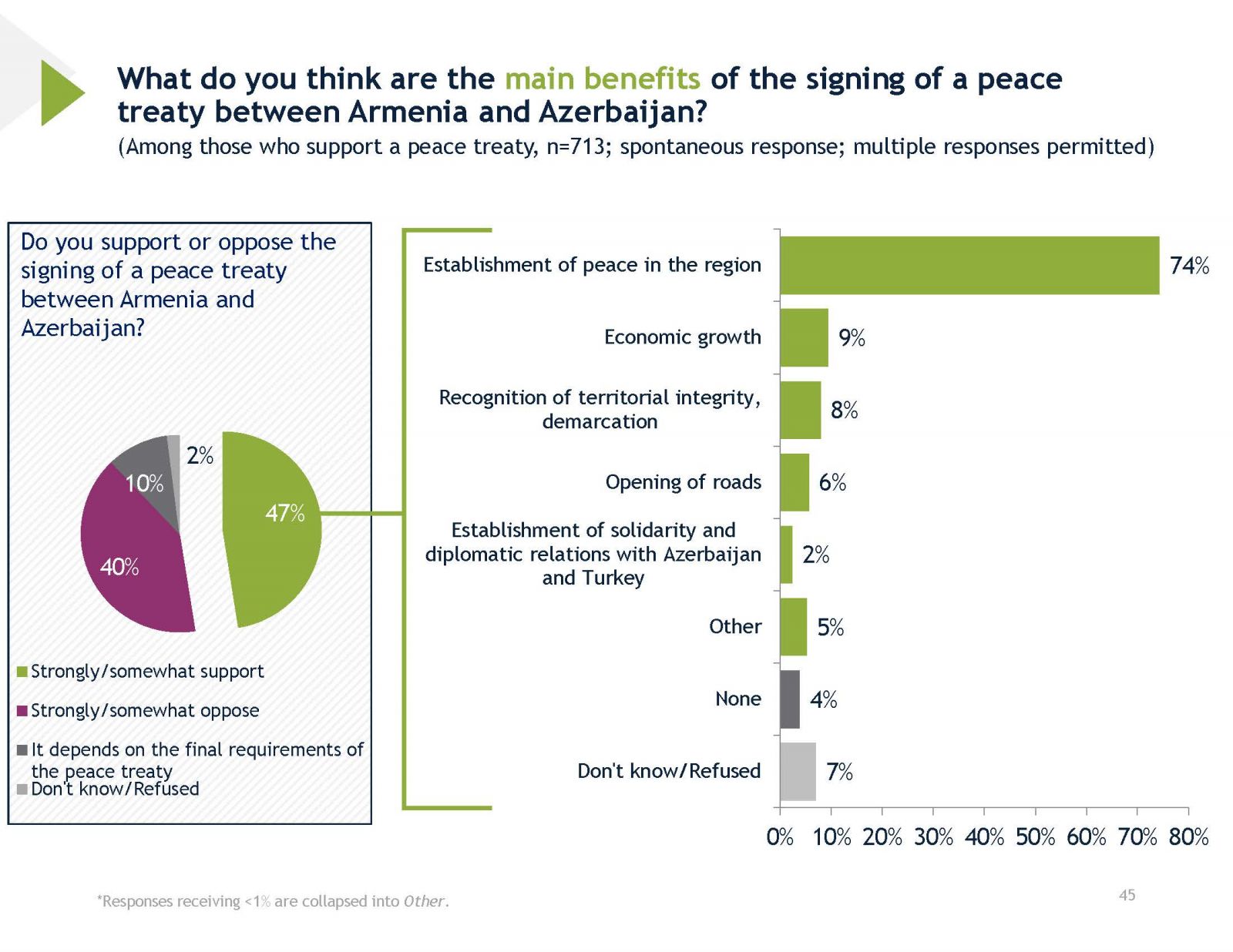
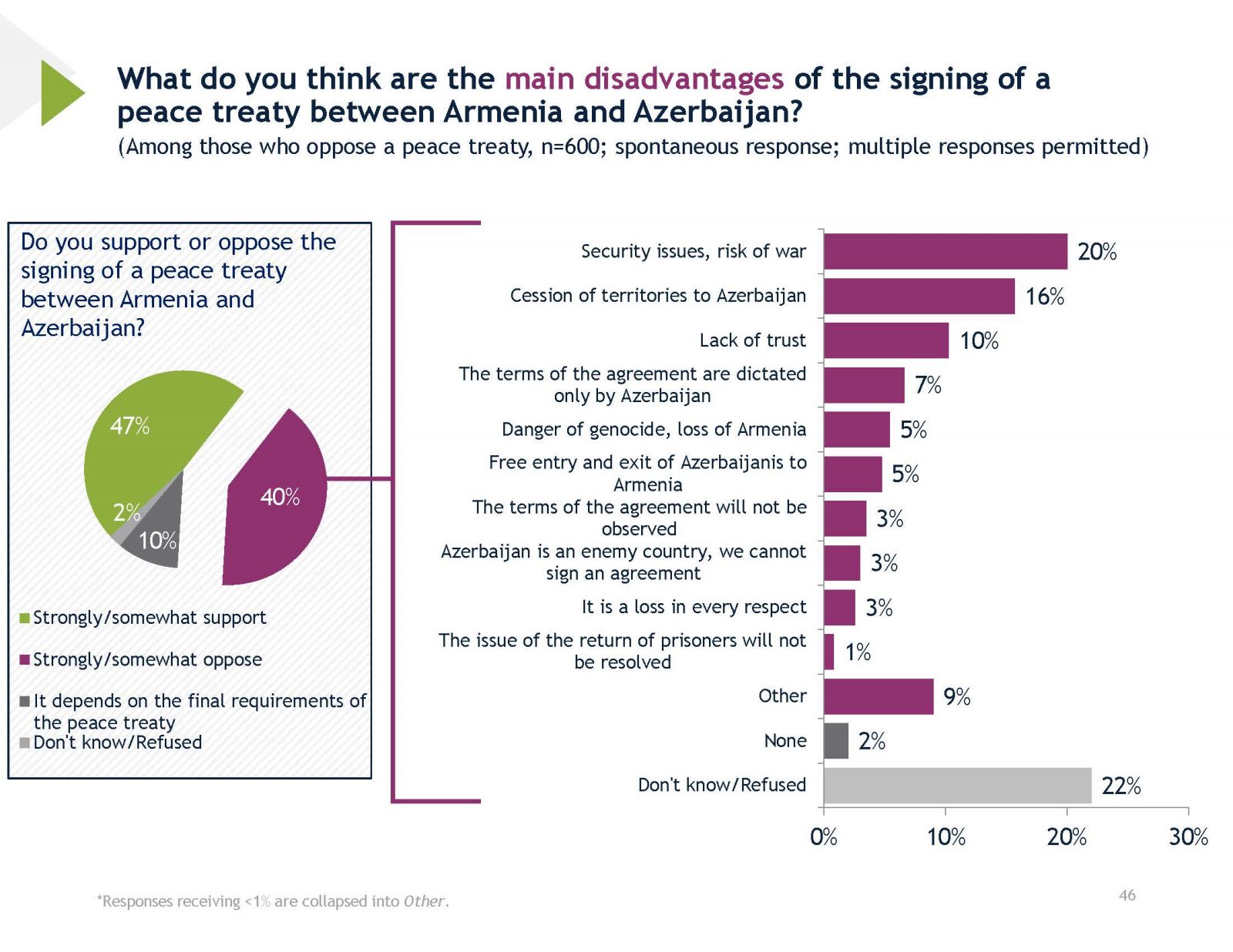
According to a public opinion survey conducted by the International Republican Institute (IRI), 47% of respondents in Armenia said they support and would endorse the signing of a peace agreement between Armenia and Azerbaijan.
When asked about the main benefits of signing a peace agreement between Armenia and Azerbaijan, 74% of respondents pointed to the establishment of peace, 9% mentioned economic development, 8% cited the recognition of territorial integrity and border delimitation, 6% referred to the unblocking of regional transport routes, and 2% said the agreement would lead to reconciliation and the establishment of diplomatic relations with Azerbaijan and Turkey. Additionally, 5% mentioned other benefits, 4% believed the agreement would bring no benefits, and 7% either refused to answer or found it difficult to respond.
Data was collected from June 16-26, 2025 through CATI administered telephone interviews. The sample consisted of n=1,505 resident citizens of Armenia and forcibly displaced former residents of Nagorno Karabakh who are now residing in Armenia (who may or may not be citizens). Residents who have lived in Armenia for fewer than six months were excluded from the sample. It is representative of the population with access to a mobile phone, which excludes approximately
1.7% of adults.
Phone numbers were selected via random digit dialing (RDD). The sample frame includes all possible mobile phone numbers (all prefixes), and the status of non-working or invalid numbers were recorded if they were called during fieldwork. Mobile phones are assumed to be a personal device and the person who answered the phone was selected to be interviewed. Up to three total contact attempts were made for working phone numbers that were not deemed to be ineligible.
The achieved sample was weighted for age, gender, regions, and urbanicity according to the 2023 Yearbook of the Statistical Committee of Armenia and education; the education weight target has been calculated to the midpoint between the 2022 census data (for those aged 18+) and the achieved sample’s education level.
The response rate was 25%. The margin of error does not exceed ±2.5% for the full sample. Charts and graphs may not add up to 100 percent due to rounding.