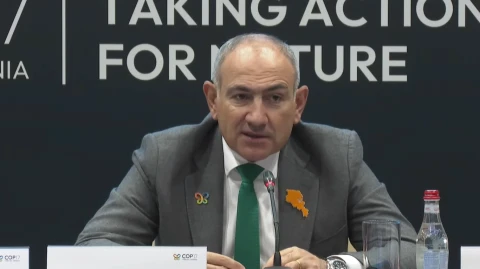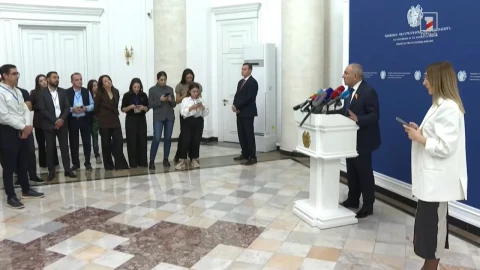
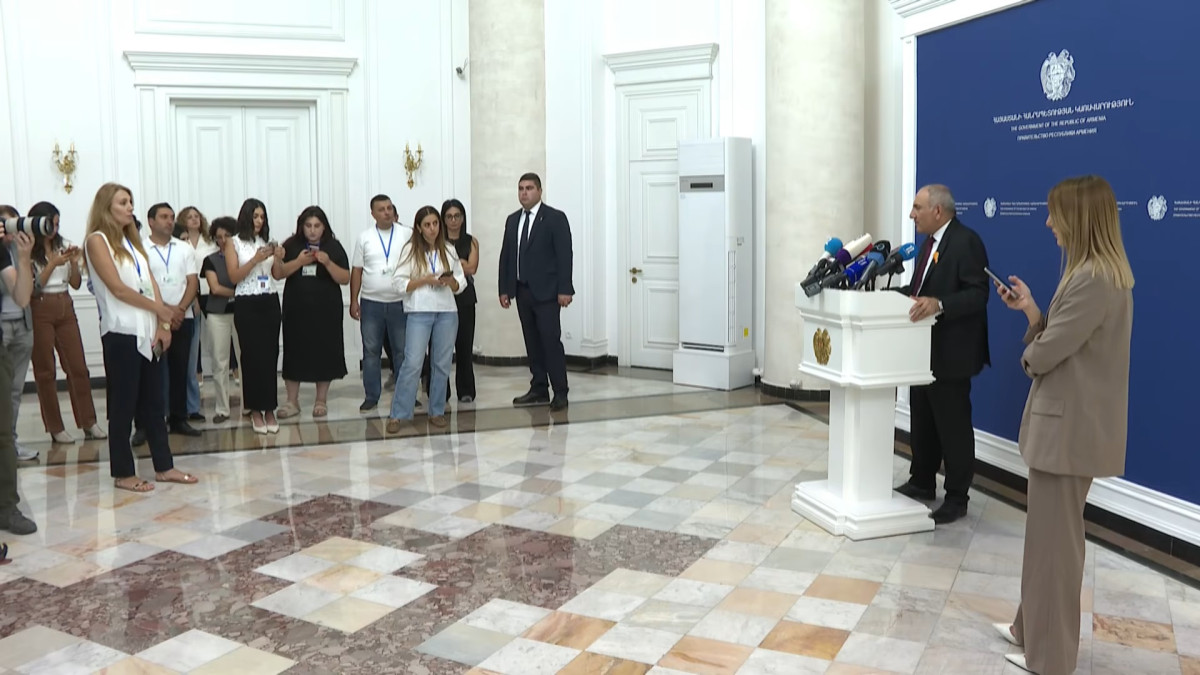
“We want to say this directly: Armenia cannot be forced to hold a referendum. What does it mean to force a referendum?” Prime Minister Nikol Pashinyan said at a press briefing, responding to a journalist’s suggestion that Russia was pressuring Armenia to hold a referendum on choosing between the Eurasian Economic Union (EAEU) and the European Union (EU), following the Pashinyan-Putin meeting.
Referring to his conversation with Russian President Vladimir Putin, Pashinyan explained that he had told the Russian leader that if Armenia were to hold a referendum, it would do so when it could present the people with a clearly formulated question: there is such a law-should we adopt it or not?
“Now, a referendum can take place only under one circumstance. There are procedures for joining the EU, and our Constitution also stipulates that joining a supranational organization requires a referendum. When that issue has matured sufficiently-I am not saying well or perfectly, but sufficiently-we will follow that path,” Pashinyan said.
The prime minister stressed that Armenia has not officially applied for EU membership. Nor, he said, has there been any discussion of granting Armenia candidate status, agreeing on a roadmap, or launching working negotiations on the issue.
Pashinyan questioned how a referendum campaign could be conducted under such circumstances.
“If we call a referendum, there will have to be a campaign. Can we conduct a campaign? Whatever question people ask, are we going to say, ‘Dear people, this is not yet clear, we still have to clarify it’? The people will say, ‘If it is not clear, why have you brought it before me and put a question before me that does not exist?’” he said.
According to Pashinyan, Armenia should first formulate the question and the possible answers before asking the public to make a choice.
“We are not going to take people to polling stations for the sake of it when there is neither a question nor an answer,” he said.
Pashinyan also recalled that there is a defined procedure for leaving the EAEU: a country must notify its partners six months in advance. Armenia, he stressed, has made no such notification.
The prime minister made the remarks after his meeting with Putin in Bishkek on the sidelines of the SCO+ summit. During the meeting, Pashinyan said that Armenia’s process related to the European Union is not directed against Russia or the EAEU. He reiterated that Armenia has not yet reached the point where a choice needs to be made, and that when a genuine moment of choice arrives, Armenia will make the necessary decision, with or without a referendum.